
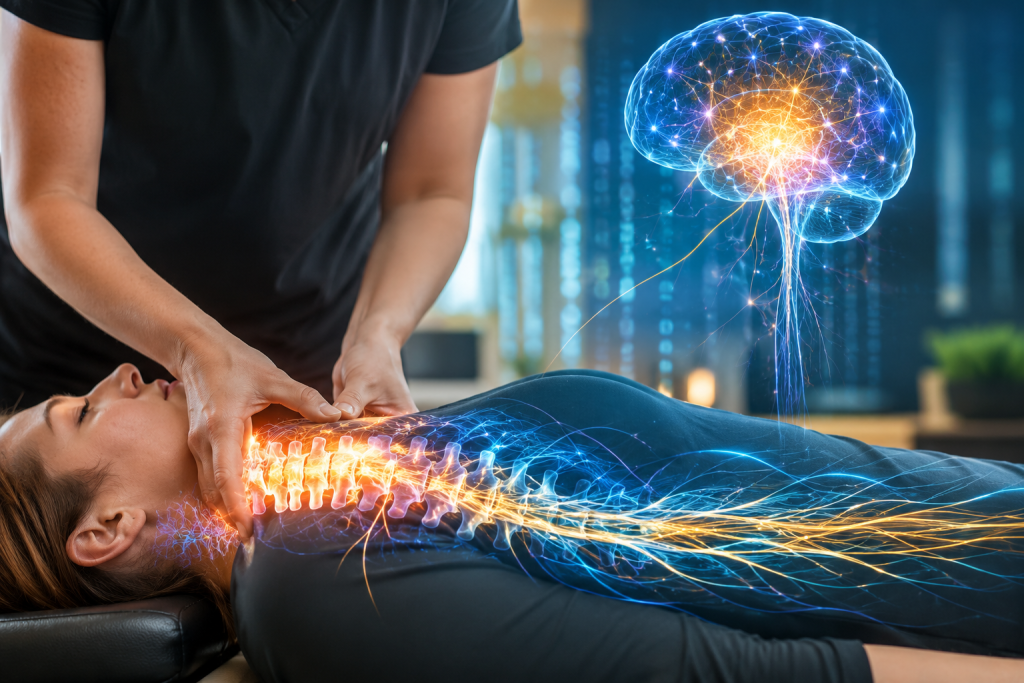
 Can a chiropractic adjustment actually change how your nervous system functions? A pilot study out of the University of Chicago Medical Center and Rush Medical Center found that a single adjustment lowered blood pressure as much as two hypertension medications combined.
By Dr. Michael Carberry, DC — President, Advanced Medical Integration
Most people think of a chiropractic adjustment as something that happens to a joint. It’s not. It’s something that happens to a brain — and there’s a growing body of research to back that up.
I’ve spent my career on both sides of healthcare, running multiple practices across states I’ve never even lived in, several doing well over $1 million a year, one as high as $5 million. People sometimes assume that means I care more about the business than the medicine. It’s the opposite: the business worked because the science does.
Symptoms Show Up Last
Every disease process has a timeline. It starts long before you feel anything, and you’re typically more than halfway through a disease before a symptom ever appears — a symptom is usually the last 15 to 20% of the process, which also makes it the first thing to disappear once a drug suppresses it.
Traditional medicine is built to intervene at that final stage. Ninety-seven percent of all drugs ever invented were designed for symptom management, not for resolving what caused the symptom in the first place — and most of them are inhibitory, meaning their job is to stop a process rather than fix one. That approach is expensive: the world spends about $9 trillion a year on healthcare, and the U.S. accounts for $5.2 trillion of it despite being only 4.2% of the world’s population. A lot of that spending shows up as prescriptions — enough that, divided evenly across the population, Americans are effectively on 18 to 20 medications a day.
If the strategy is “stop the symptom,” you eventually end up with a country full of people whose underlying problems were never addressed. That’s not a controversial statement anymore — it’s just a description of where U.S. health outcomes currently sit.
So the real question isn’t “how do we suppress this symptom.” It’s “why did this symptom show up in the first place.” That question points somewhere most people don’t expect: the brain.
The Body’s Real Priority
The brain has one job: perceive the environment and generate a response that keeps you alive and able to reproduce. Everything else is downstream of that. Most people assume the brain spends most of its energy monitoring the body’s internal environment — hormones, organs, chemistry. It doesn’t. Roughly 90% of the sensory information the brain processes is about the external environment, because that’s where the threats are. It’s fight-or-flight, running constantly in the background.
That external-environment sensing runs through proprioception — the network of nerve endings that tell your brain where your body is in space, how the ground beneath you is changing, whether you’re on stable footing or not. If you step out of your office and there’s a mountain lion in the parking lot, what you do in the next three seconds depends entirely on how well that system is feeding your brain accurate information.
I understood this on an intellectual level for years. It became visceral for me through my wife’s work. She spent her career in traumatic brain injury and stroke rehabilitation, supervising physical therapy departments and helping people wake up out of comas. When I was injured, stopped taking medication, and went to a chiropractor instead, she came along skeptical — and watched the adjustment happen. Her reaction: “These guys are tapping into the keyboard to the brain.”
Her reasoning: in coma rehab, one of the first things they do is strap a patient into a tilt table and bring them into a weight-bearing position — unconscious. That single act activates proprioceptive nerve endings throughout the body and starts driving input back to the brain. It’s not incidental. It’s the intervention.
Where the Keyboard Lives
The vast majority of proprioceptors sit in your weight-bearing joints, and roughly 90% of those weight-bearing joints run between the occiput and the sacrum — your spine. The single highest-concentration points are C1 at the top and the SI joints at the bottom. Those aren’t arbitrary areas of chiropractic focus. They’re the densest input points on the entire keyboard.
Stimulating those joints through mobilization drives synaptogenesis — the formation of new neural pathways. A stuck vertebra doesn’t just sit there quietly; it reduces the volume of proprioceptive signals reaching the brain, the same way a few missing keys degrade what you can type.
There’s a simple way to see this playing out in your own patients. A June 2022 study in the British Journal of Sports Medicine found that middle-aged and older adults who cannot balance on one leg for 10 seconds have roughly double the risk of death within the following years (Araujo et al., 2022). Try it on your next ten patients — the majority won’t be able to hold it, and the reason is almost always the same: the proprioceptive input to their brain has been compromised. Addressing that isn’t really in most other providers’ scope of practice. It’s squarely ours.
One Joint Problem Becomes a Cascade
The biomechanics compound on each other. If C1 is misaligned, the sacrum tends to follow — and a sacrum that isn’t moving properly reduces imbibition (nutrient exchange) at the L4-L5 and L5-S1 discs, which is exactly where you tend to see accelerated degeneration on imaging. That’s not simple aging. It’s altered aging, driven by a mechanical problem further up or down the chain.
The surrounding musculature gets pulled into it too — a PI ilium jams the SI joints, tightens the piriformis and glute medius, and shuts down both proprioception and normal joint inhibition at the same time. Rehab work that restores those muscles, combined with adjustments that restore movement to the joint itself, is addressing two compromises to a patient’s health simultaneously, not one.
In an integrated practice, this is also where combining tools helps. We’ve had cases where a medical provider performed a joint injection — even something as simple as saline or lidocaine — on a stuck SI joint, after which the adjustment itself became noticeably easier to deliver and the patient’s outcome improved substantially. It’s a reminder that “medical” and “chiropractic” aren’t competing approaches to the same problem; they can unstick each other.
The Nervous System Evidence
None of this is just theory. Spinal manipulative therapy has been shown in published research to increase parasympathetic control — shifting the nervous system out of fight-or-flight and into rest-and-repair mode, including in studies looking at a single pre-exercise session. Reviews of spinal manipulation have found it to be a valid, effective tool for chronic low back pain, fibromyalgia, migraine, certain GI dysfunctions, and depression.
One of the more striking findings came out of a 2007 pilot study associated with the University of Chicago Medical Center and Rush Medical Center (Bakris et al., 2007), which set out to compare hypertension medications and combinations of them for blood pressure control. A single chiropractic adjustment to C1 was used as a comparison arm — and it lowered blood pressure to a degree comparable to two hypertension medications given together, for up to eight weeks. Worth saying plainly: it was a small pilot study, not a large-scale trial — a caveat that belongs next to the finding, not a reason to leave the finding out. That’s a study worth having framed in your reception area, and worth sharing with any medical provider you work alongside, because it’s their research validating what we do.
There’s also emerging interest in forward head posture as a marker researchers have connected to longevity, tied to its effect on the vagus nerve as it exits near the foramen magnum. Restoring the cervical curve doesn’t just relieve mechanical tension on the cord — it opens space around nerves that play a direct role in shifting the body out of fight-or-flight.
Beyond the Adjustment
The same principle extends into rehab and exercise. Most gym-style exercise happens in the sagittal plane — bench presses, bicep curls — which is good for muscle but becomes automatic quickly and does relatively little for the brain. Movement in the coronal plane, even something as simple as sliding jacks or bird-dog exercises engaging the lateral multifidus, forces the brain to build a new pathway because it’s unfamiliar. That’s the mechanism some researchers now point to as a potential piece of Alzheimer’s prevention.
It applies to kids, too. Growing up with four daughters, I used to come home to them bouncing off the couch onto a BOSU ball — which looked like chaos and was actually my wife deliberately programming their developing brains through varied proprioceptive input. One neurologist has reported real success helping kids with attention deficit disorder using a similarly simple tool: standing on a wobble board while playing catch, engaging alternating right-left coordination while maintaining balance — enough novel input to shift the brain’s function without medication.
The Bigger Point
Chiropractic care, on its own, does something no drug on the market is built to do — it restores the raw sensory input the brain depends on to organize the rest of the body. Add rehab, and you compound the effect. Add appropriate medical treatment alongside it in an integrated setting, and you have a combination that addresses function instead of managing symptoms indefinitely.
Understanding this — really understanding the neurology behind what an adjustment does — changes how you talk to patients, how you talk to referring providers, and how you think about your own value in the healthcare system.
Frequently Asked Questions
How does a chiropractic adjustment affect the nervous system?
Adjustments stimulate proprioceptors — nerve endings concentrated in the spine’s weight-bearing joints — which serve as a primary source of sensory input to the brain. Restoring movement to a restricted joint increases that input, supporting the brain’s ability to organize movement, balance, and autonomic (fight-or-flight versus rest-and-repair) function.
Can a chiropractic adjustment actually lower blood pressure?
A 2007 pilot study associated with the University of Chicago Medical Center and Rush Medical Center found that a single adjustment to the C1 vertebra lowered blood pressure to a degree comparable to two hypertension medications combined, for up to eight weeks. It was a small pilot study, so it isn’t the last word, but it’s a real, published finding worth knowing about.
What is proprioception, and why does it matter?
Proprioception is the body’s sense of its own position and movement in space. It’s concentrated in weight-bearing joints — most densely at the top of the neck (C1) and the sacroiliac joints — and makes up a large share of the sensory information the brain uses to manage balance, coordination, and the fight-or-flight response.
Why do most medications only manage symptoms instead of resolving the underlying cause?
The majority of drugs ever developed are inhibitory — designed to block or suppress a process, such as pain, inflammation, or elevated blood pressure, rather than correct the mechanical or functional issue causing it. That can provide real short-term relief, but it doesn’t address why the symptom appeared in the first place.
What does the one-leg balance test measure, and why does it matter?
The ability to hold a single-leg stance for 10 seconds is a simple proxy for how well the brain is receiving and processing proprioceptive input. A 2022 study in the British Journal of Sports Medicine found that middle-aged and older adults who couldn’t complete the test had roughly double the mortality risk of those who could.
Want to talk about integrating this into your practice? Reach out to Advanced Medical Integration at www.amidoctors.com, or find us on YouTube at Advanced Medical Integration.
Sources
- Bakris G, Dickholtz M Sr, Meyer PM, et al. “Atlas vertebra realignment and achievement of arterial pressure goal in hypertensive patients: a pilot study.” Journal of Human Hypertension, 2007. org/10.1038/sj.jhh.1002133
- Araujo CG, et al. “Successful 10-second one-legged stance performance predicts survival in middle-aged and older individuals.” British Journal of Sports Medicine, 2022. org/10.1136/bjsports-2021-105360
- Research on spinal manipulative therapy and parasympathetic nervous system activity (specific study links to be confirmed before publishing)
- Systematic review of osteopathic/spinal manipulation for chronic low back pain, fibromyalgia, migraine, and related conditions (specific study link to be confirmed before publishing)
About the Author
Dr. Michael Carberry, DC, is President and founder of Advanced Medical Integration (AMI), which has grown to more than 1,000 independent practices across the U.S. and has been named to the Inc. 5000 for five consecutive years. Dr. Carberry holds a B.S. in Marketing from Stockton University and a Doctor of Chiropractic from Life University, and is the author of The Death of American Healthcare. He speaks nationally on healthcare, business, economics, and the opioid crisis, and serves as a trustee for Delphi Schools Inc.